Worn spark plugs don't just make your engine run rough. They force ignition coils to work harder, push raw fuel into your catalytic converter, drag down your gas mileage, and can eventually damage pistons and valves. Here's what's actually happening inside your engine — and why the replacement interval matters more than most drivers assume.
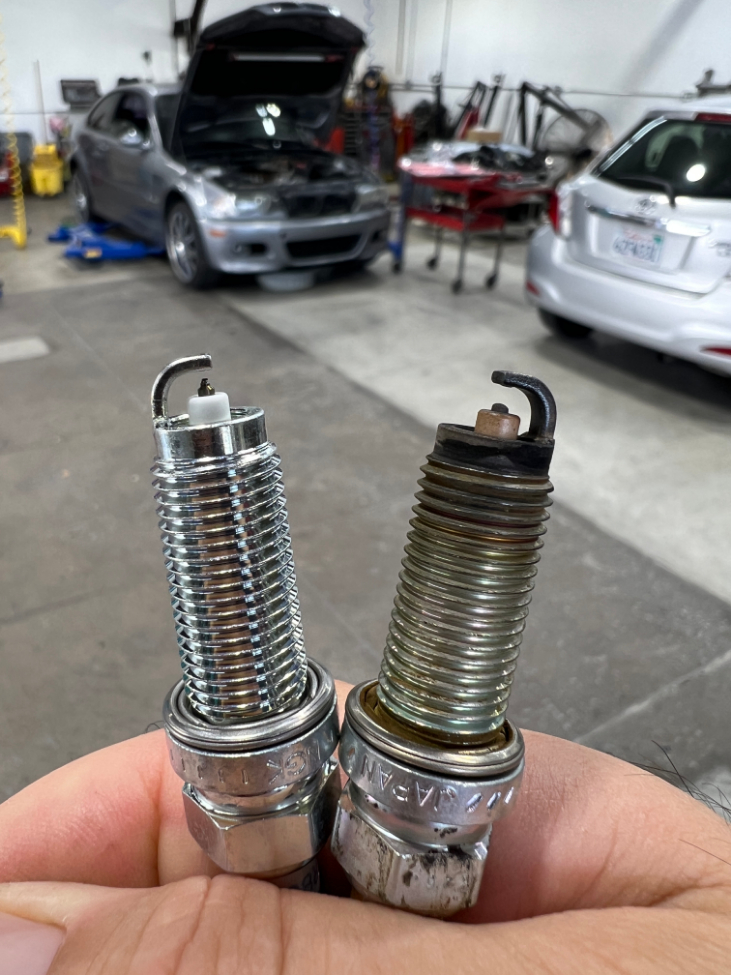
New spark plug compared to worn spark plug removed from customer vehicle at Hyarcs Auto Repair in Pasadena CA
Most people know spark plugs need to be replaced eventually. What they don't realize is how much a worn set can damage other parts while it's waiting to be swapped out. A bad spark plug isn't just a bad spark plug. It's a problem that spreads.
What Spark Plugs Actually Do
Spark plugs ignite the air-fuel mixture inside each cylinder at a precise moment. That controlled combustion pushes the piston down, turns the crankshaft, and moves the car. Simple enough.
The problem is that spark plugs wear out. The electrode at the tip erodes. The gap between the electrodes widens. A wider gap means the spark has to jump farther — and that takes more voltage, more heat, and more work from everything connected to it.
Copper plugs typically last around 30,000 miles. Iridium and platinum plugs in makes like Toyota, Honda, and BMW can go 60,000 to 100,000 miles depending on the vehicle and driving conditions. Many drivers go well past those intervals without noticing anything obvious — until something more expensive breaks.
How Worn Spark Plugs Damage Ignition Coils
Few drivers know this relationship exists.
An ignition coil takes 12 volts from your battery and steps it up to anywhere from 12,000 to 45,000 volts — enough to force a spark across the plug gap. On a new, properly gapped plug, that's a normal operating load. When the gap widens from wear, the coil has to push even harder to bridge it. Every firing cycle, it's working beyond what it was designed for. That extra load generates more heat inside the coil and produces voltage spikes that stress its internal windings.
A coil that might have lasted 100,000 miles on healthy plugs might fail at 60,000 or 70,000 miles on a worn set. A single ignition coil can run $50 to $200 in parts — a full set on a V6 or V8 adds up fast. A set of spark plugs for the whole engine might cost $20 to $80. The math on neglected plugs isn't pretty.
Engine Misfires: What's Happening and Why It Matters
When a spark plug can't reliably fire its cylinder, that cylinder skips a power stroke. The engine stumbles. You might feel it as a rough idle, a jerk under acceleration, or a vibration at highway speeds that wasn't there six months ago.
Misfire codes — P0300 through P0308 depending on which cylinder — trigger the check engine light. If that light is flashing rather than steady, the misfire is severe enough to risk catalytic converter damage. A flashing check engine light means get off the road and get the car diagnosed, not next week.
Beyond the discomfort, misfires put mechanical stress on the engine that builds over time. When one cylinder doesn't contribute, the others compensate. Combustion timing gets disrupted. The engine computer tries to adjust, but it can only do so much before something else starts showing the strain.
What Happens to Your Catalytic Converter
When a cylinder misfires, unburned fuel gets pushed out during the exhaust stroke. That raw fuel travels down the exhaust system and lands inside the catalytic converter — which is built to handle hot gases, not liquid fuel.
Inside the converter is a ceramic honeycomb coated with platinum, palladium, and rhodium. Exhaust gases pass through and those metals trigger a chemical reaction that converts harmful pollutants into less harmful ones. The converter needs to run between roughly 800 and 1,600 degrees Fahrenheit to work correctly.
When raw fuel hits that hot catalyst, it burns. Internal temperatures can spike past 2,000 degrees Fahrenheit. At that point, the ceramic honeycomb can melt and clog. A clogged converter restricts exhaust flow, creates back pressure, and chokes engine performance. The car loses power, runs rich, and may eventually stall.
A damaged catalytic converter doesn't recover. Replacement runs several hundred to several thousand dollars depending on the vehicle. That's the downstream cost of a $4 to $30 spark plug that was overdue.
Fuel Economy
Worn spark plugs cause incomplete combustion. The air-fuel mixture doesn't burn as efficiently, so the engine burns more fuel to produce the same power. You probably won't notice it on any given fill-up because the change is gradual. Over months, though, it adds up. Severely worn plugs can drag fuel economy down by 20 to 30 percent — real money for anyone putting meaningful miles on a vehicle.
Fresh plugs restore efficient combustion. The improvement in MPG after a plug replacement is often noticeable immediately.
Oxygen Sensors and Fuel Trims
Less discussed, but worth knowing.
Oxygen sensors monitor the exhaust stream to measure combustion quality. The engine computer reads that data and adjusts the fuel mixture continuously. When combustion is chronically incomplete from worn plugs, the sensors detect excess unburned fuel and the computer leans out the fuel trim to compensate.
Sensors that are always chasing a bad signal wear faster. A failed upstream oxygen sensor — one of the sensors before the catalytic converter — runs $100 to $300 to replace. It's one more part that takes an indirect hit from a plug that's past its service life.
Emissions and Smog Testing
Misfires and incomplete combustion push more unburned hydrocarbons and carbon monoxide out through the exhaust. In California, that's a direct route to a failed smog inspection.
STAR-certified smog testing measures exhaust emissions precisely. If your vehicle is misfiring or running rich because of worn plugs, the readings will likely be clearly elevated — not borderline, not close. The fix is usually replacing the plugs, clearing the codes, completing the OBD-II drive cycle, and retesting. If misfires have already damaged the catalytic converter, the path to passing gets longer and more expensive.
Replacing plugs on schedule is one of the simpler ways to keep a vehicle compliant and avoid the unpleasant surprise of a smog failure.
Hard Starting and Cold-Weather Performance
Worn electrodes struggle to produce a reliable spark when the engine is cold. Cold-start misfires are common with aging plugs — that brief stumble on a cold morning is often the first thing people notice. As the plugs continue to wear, cold starts get worse. The engine cranks longer before catching. On a weak battery or in genuinely cold conditions, it may not start at all.
In Southern California, winters are mild, but early mornings in the San Gabriel Valley can still drop into the low 40s. That's cold enough to expose a weak ignition system.
How to Tell If It's the Plugs or the Coil
The symptoms overlap enough that it's worth knowing the general patterns:
- Multiple cylinders misfiring on a high-mileage vehicle with no recent plug service usually points to worn plugs
- A single cylinder misfiring that follows the coil when it's swapped to another cylinder is usually a bad coil
- Misfire codes that get worse under load and heat tend to point toward coils
- A rough idle that clears up when the engine warms up can go either way, but lean toward plugs if they're overdue
A controlled swap test — moving the coil to a different cylinder to see if the misfire moves with it — is one of the cleanest ways to confirm a coil failure without replacing parts blindly. For a diagnostic reading at the source, a scan with live misfire counter data narrows it down quickly.
When to Replace Spark Plugs
- Copper plugs: 30,000 miles
- Platinum plugs: 60,000 miles
- Iridium plugs: 60,000 to 100,000 miles
Check the owner's manual for what your specific vehicle calls for. Some engines are finicky about plug type and heat range — using the wrong plug can cause its own set of problems. If you don't know when your plugs were last replaced, that's effectively your answer.
Frequently Asked Questions
Can worn spark plugs damage an ignition coil? Yes. When the electrode gap widens from wear, the coil has to generate higher voltage to fire the cylinder reliably. The added workload creates heat and voltage spikes inside the coil, shortening its service life. Coils on a neglected ignition system often fail years before they would on a maintained one.
How do I know if it's the plugs or the coil causing a misfire? Multiple cylinders misfiring on a car that's overdue for plugs usually means plugs. A single cylinder misfiring on and off — especially when the engine is hot or under load — points more toward a coil. If the misfire moves to a different cylinder after a coil swap, the coil is confirmed. A diagnostic scan with live data gets there faster than guessing.
Will bad spark plugs cause a smog failure? They can. Misfires and incomplete combustion raise hydrocarbon and carbon monoxide readings in the exhaust. In California, that typically means a failed STAR smog inspection. Replacing the plugs and running the drive cycle before retesting usually fixes it — unless the catalytic converter has already been damaged by extended misfiring.
What does it cost to fix damage from worn spark plugs? Spark plugs: $20 to $80 for a full set, plus about an hour of labor. A single ignition coil: $50 to $200. Catalytic converter replacement: several hundred to several thousand dollars. Piston or valve damage from prolonged misfiring: potentially more than all of that combined. The maintenance cost is a fraction of any of the repairs.
Do I need to replace all spark plugs at once? Yes. They all have similar mileage on them. Replacing one or two creates uneven ignition across cylinders and sets you up to be back in the shop soon for the rest. Do the whole set and be done with it.
Is it safe to drive with a misfiring engine? Long enough to get to a shop, maybe. Not longer. Continued driving on an active misfire risks the catalytic converter and stresses the coils. A flashing check engine light means the misfire is severe enough to cause damage in real time — that's not a situation for waiting until the weekend.
Spark plugs are among the least expensive maintenance items on any vehicle. The parts they protect — coils, catalytic converters, oxygen sensors — are significantly more expensive. If the plugs are overdue, the case for replacing them isn't really about the plugs.
If you're in Pasadena or anywhere in the San Gabriel Valley and you're not sure when your plugs were last serviced, or you've got a rough idle or check engine light that's been sitting, Hyarcs Auto Repair does full ignition system diagnostics. We'll tell you what's actually going on before recommending any parts.
Hyarcs Auto Repair | 2162 E Villa St, Pasadena, CA 91107 | (626) 432-4540
Have a Question? We're Here to Help.
Call us or book an appointment in Pasadena — same-day service often available.